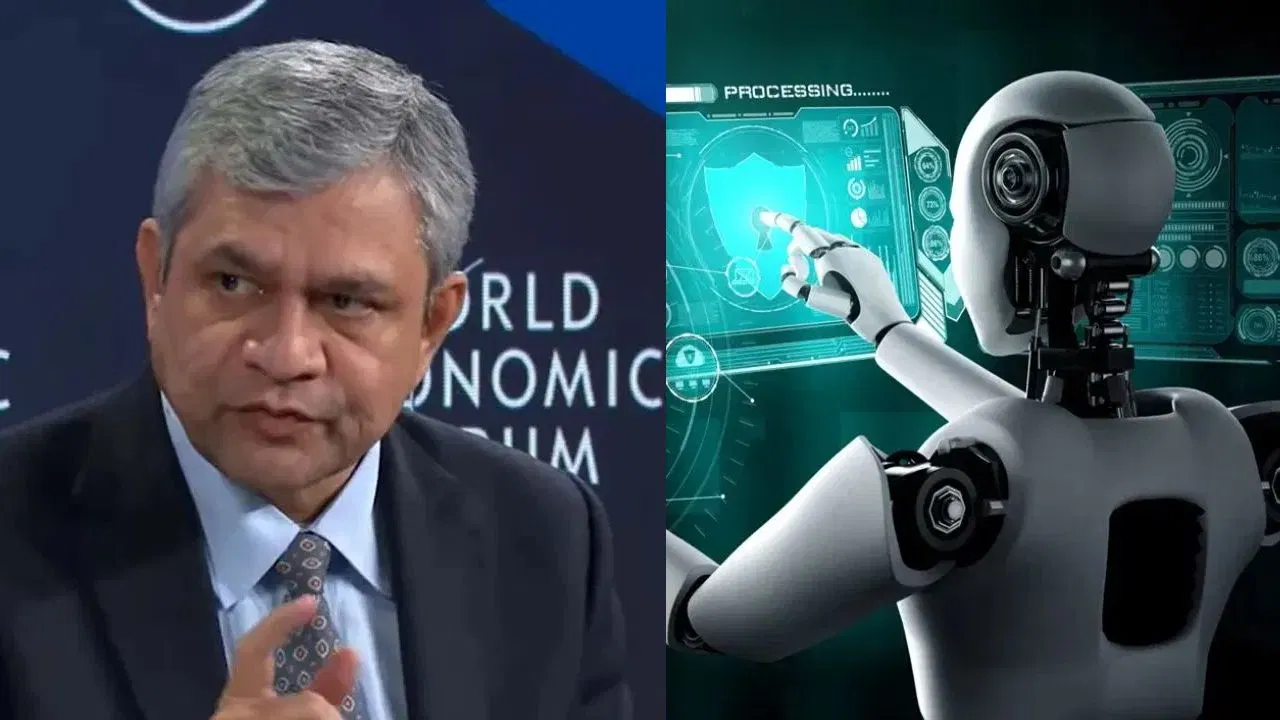
Union Information and Technology Minister Ashwini Vaishnav has commented on AI. Ashwini Vaishnav said that India is working on a complete artificial intelligence (AI) ecosystem. The current competition is between the leading countries of the world. During a discussion at the World Economic Forum (WEF) in Davos, Switzerland, IMF Managing Director Kristalina Georgieva announced a new indicator of countries’ readiness for AI. At this time, the countries of the world were divided into three groups. Those who lead the change, only observe and do not know the change. While the US, Denmark and Singapore top the list, India is in second place along with emerging markets like Saudi Arabia. Although India’s growing investment in the IT sector has been praised, it has not been included in the top group.
India should not be underestimated in AI – Vaishnavism
Union Minister Ashwini Vaishnav speaking on the IMF ranking said that India is not in the second group but in the first group. India is among the first group of world leaders in AI and India should not be underestimated. Explaining India’s strategy, the minister said the country is simultaneously working on five key AI architecture layers. Application, Model, Chip, Infrastructure and Power. India is making significant progress in all these areas and is not limited to just one level. Our AI capabilities will further strengthen the country’s economic future.
Speaking further, Ashwini Vaishnav said that technology is not running towards big models but towards practicality. India’s real advantage lies in the proper use of AI. Big AI models cannot be profited from being created, but can only be used to solve business and day-to-day problems. India is developing a comprehensive set of intelligent models with 20 to 50 billion parameters, which are already being applied to increase productivity in sectors such as agriculture, health and education.
AI provides accurate answers when asked. Citing data from Stanford University, Ashwini Vaishnav said that instead of following others, India is forging its own path in the field of AI. India ranks third in the world in AI penetration and second in terms of AI talent. A major AI summit will be held in India next month. Here India will showcase comprehensive, secure technologies in the field of AI. Vaishnav also said that India is poised to emerge as a new force in the global AI debate rather than lagging behind US-China.
5 layers of India’s AI stack
Application level: AI creates value in the real world
- The top tier of the AI stack, closest to citizens and industry
- India’s strategy focuses on diffusion of AI at the population level -> value is realized through widespread use
- Impact on agriculture, healthcare, education, manufacturing, administration
Model Layer: The brain behind the application
- AI models power intelligence and decision-making -> drive applications
- Advanced models showed the potential of AI, but were expensive in terms of computing power and capital
- Open-source models lowered costs and barriers to entry
- The India model enables localization for Indian languages, regions and regulations
- Sovereign models -> data security, cultural compatibility, strategic autonomy
Chip/Compute Layer: The chips that run the AI
- Compute enables training and prediction of AI models -> GPU, TPU, NPU, etc.
- Affordable and accessible computing essentials for startups and researchers
- Subsidized GPU access under national missions democratizes AI development
(38000+ GPU at 1/3 price of global average) - Semiconductor fabs and ATMP units to build chip development capacity in India
Data Center Layer: The backbone of digital infrastructure
- Data centers host AI models, data and computing resources
- Massive investments are increasing local data-center capacity ($70 billion so far from giants like Google, Microsoft and Amazon).
- Innovations are improving cooling, water efficiency and energy consumption
- Digital strengthens sovereignty and creates high-value jobs
Energy Layer: Massive AI Powering (Law of Peace)
- AI infrastructure requires reliable, round-the-clock power
- AI and the expansion of data-centers are rapidly increasing the need for electricity
- Renewable energy is essential, but not uninterrupted for 24×7 AI workloads
- Nuclear power provides clean, stable baseload power
- Peace Act -> Nuclear power-based AI infrastructure through small modular and micro reactors, public-private partnerships and foreign investment